
Earth's New Mini-Moon: How a Tiny Asteroid Got Captured
Earth's new mini-moon is a tiny asteroid caught by our gravity since April. See why slow approach speed makes capture possible and why it leaves within months.
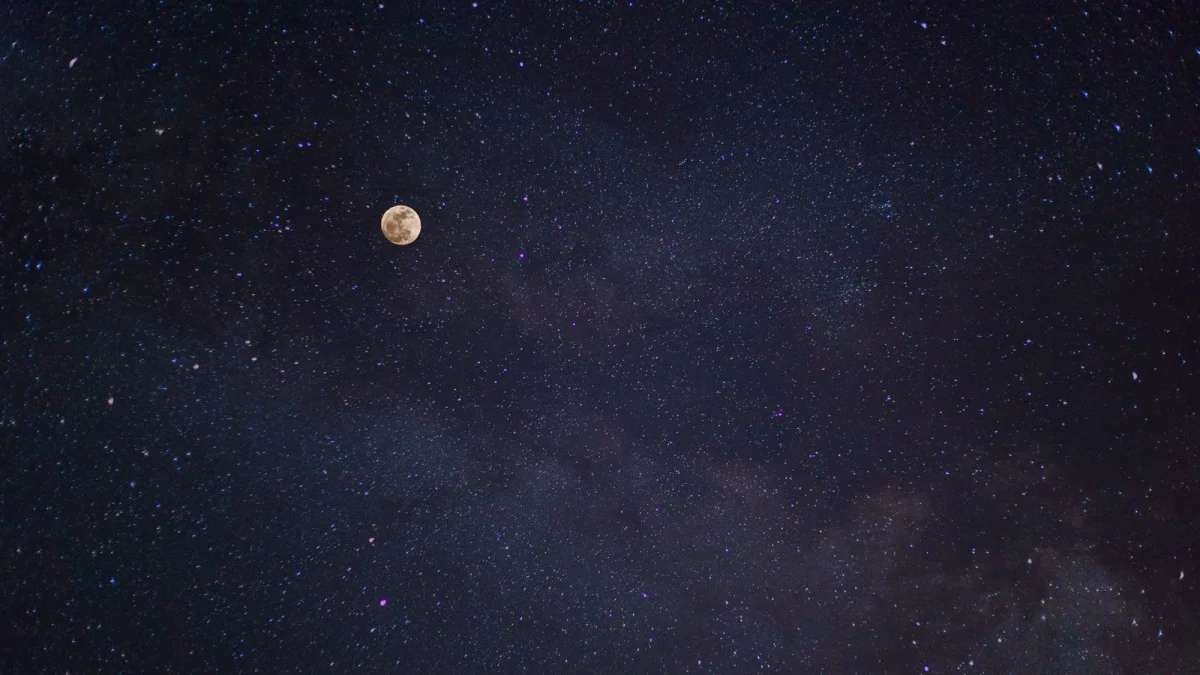
Table of contents
Look up on a clear December night and you will see one moon. There are two. The second is a rock roughly the size of a refrigerator, looping around Earth well beyond the orbit of the real Moon, far too faint for any backyard telescope.
Astronomers confirmed in late October that Earth's new mini-moon, a tiny asteroid designated 2026 QQ8, has been gravitationally bound to our planet since around April. It will not stay. By around the turn of the year it is expected to slip free and go back to circling the Sun on its own.
Its visit is short, but it answers a question most people never think to ask: how does a planet pick up a moon at all, and why does it so rarely keep one? The answer comes down to speed, a boundary in space you can calculate on a napkin, and a test that tells a rock apart from a spent rocket.
Meet Earth's New Mini-Moon
Hungarian astronomer Krisztián Sárneczky first spotted the object on August 20, according to BBC Sky at Night Magazine. It was so small and faint that the Minor Planet Center, the international clearinghouse for asteroid observations, initially suspected it was space debris rather than a natural body.
Follow-up observations with the Lowell Discovery Telescope in Arizona and the University of Hawaii's 2.2-meter telescope confirmed it was natural. The Minor Planet Center formally announced it on October 29.
Size estimates range from about 1 meter to 2 meters across. That makes it tiny by asteroid standards but large for a mini-moon. Modelling reported by space news outlets has put the average temporary moon at about 75 centimeters, roughly 30 inches, wide.
Where it is and when it leaves
- Captured: around April, when it crossed into Earth's gravitational zone of control.
- Closest approach this visit: about 537,000 kilometers (334,000 miles) on August 18, according to NASA JPL's close-approach data.
- Expected departure: December or January, as Earth's grip loosens and the Sun's pull takes over again.
- Next close pass: December 2058, when JPL's orbit puts it about 1.9 million kilometers away.
There is no danger. An object this small would burn up high in the atmosphere if it ever hit, much like the larger fireballs in an active meteor shower.
Why Capture Is All About Speed
Most asteroids that pass Earth are moving far too fast to be caught. They swing past on their own orbits around the Sun, bent slightly by Earth's gravity, and keep going. To be captured, a rock has to arrive almost at a crawl compared with Earth.
That only happens when the asteroid's orbit is nearly a copy of ours. QQ8 takes about 359 days to circle the Sun, according to NASA JPL's orbit solution, compared with Earth's 365. Its path is also close to Earth's in size and tilt. So the two bodies travel side by side, and the gap between them changes slowly.
Think of two cars on a highway. If you pass a parked car at 70 mph, there is no time to hand anything across. If you pull alongside a car doing 69, you could pass a coffee through the window. Earth and QQ8 are the second pair of cars.
Why mini-moons never stay: the same slow approach that makes capture possible makes the orbit fragile. The rock is barely bound, so the Sun's and Moon's tugs keep reshaping its path until, after months, it slips back out the way it came in.
The Hill Sphere: Earth's Zone of Control, Worked Out
Every planet has a region where its gravity outweighs the Sun's tidal pull on a small object. Astronomers call it the Hill sphere. Inside it, a moon can orbit the planet. Outside it, the Sun is in charge.
You can estimate its size with one formula: the planet's distance from the Sun, times the cube root of the planet's mass divided by three times the Sun's mass.
- Earth's mass is about 3 millionths of the Sun's, or 0.000003.
- Divide by three: 0.000001.
- The cube root of one millionth is one hundredth, 0.01.
- Earth sits about 150 million kilometers from the Sun. Multiply by 0.01.
The answer is about 1.5 million kilometers, nearly four times the Moon's distance of about 384,000 kilometers. QQ8's closest pass of about 537,000 kilometers sits comfortably inside that boundary, a little over a third of the way out.
One more detail hides in that math. Orbits near the edge of the Hill sphere are unstable, so long-lived moons sit well inside it. A loosely held rock that wanders toward the boundary is always one nudge from escaping.
Rock or Rocket? How Astronomers Tell
The early suspicion that QQ8 was debris is common. Spent upper stages from Moon and planetary missions end up on orbits around the Sun that look a lot like Earth's, because that is where they were launched from. Several "new asteroids" have turned out to be old rocket hardware.
The tie-breaker is sunlight. Light carries a tiny push called solar radiation pressure. A hollow metal rocket stage has a lot of surface area for very little mass, so sunlight nudges it measurably off course over weeks. A solid rock of the same size is far heavier and barely budges.
That test settled an earlier case. When the 10-meter asteroid 2024 PT5 lingered near Earth, NASA's Center for Near Earth Object Studies found that the radiation pressure on its trajectory was far too small for an artificial object. As one researcher put it in NASA's announcement, the way it moved showed it was "much denser than space debris."
Some mini-moons may be pieces of the Moon
That same object delivered a surprise. Spectra taken with the Lowell Discovery Telescope and NASA's Infrared Telescope Facility showed 2024 PT5 was rich in silicate minerals that match lunar rock samples, not typical asteroids. The team, publishing in The Astrophysical Journal Letters, concluded it was likely ejected from the Moon by an impact a few thousand years ago.
That makes sense of the orbits. A chunk blasted off the Moon would start on a path around the Sun very close to Earth's own, exactly the slow-drifting kind that gets temporarily captured. NASA notes that 2024 PT5 doubled the number of known asteroids thought to come from the Moon, joining an object called Kamo'oalewa found in 2016.
How Common Are Mini-Moons?
The first temporarily captured object was detected in 2006. The second, 2020 CD3, was identified in February 2020 after an estimated year or more in orbit, and left around March 7, according to orbit calculations by astronomer Bill Gray. It was only about 3 feet wide.
Recent research suggests Earth may host up to six mini-moons at any given time. We almost never see them because they are small, dark and moving against a sky full of stars. Finding one takes a survey telescope watching the right patch of sky on the right night.
Larger captures would stay longer. Researchers have estimated that an object about 3 meters wide could remain for 10 to 20 years. None that size has been found yet.
- Planetary defense: tracking tiny objects near Earth tests the same detection pipelines used to find hazardous asteroids, the kind missions like DART and Hera are learning to deflect.
- Cheap science targets: a mini-moon is close and slow, so a spacecraft could reach it with far less fuel than a typical asteroid mission.
- Lunar samples in orbit: if some are Moon fragments, they are free lunar rock delivered to our doorstep.
Spacecraft use the same slow-approach physics in reverse. Mission planners loop probes past Earth to adjust their speed, as NASA's ESCAPADE Mars mission did on its way out.
Related reading: Orbital Decay: Why NASA's Swift Telescope Fell to Earth.
Frequently Asked Questions
Does Earth have a second moon right now?
Temporarily, yes. A small asteroid designated 2026 QQ8 has been bound to Earth since around April and is expected to leave in December or January. It is only a meter or two across and far too faint to see without a large telescope.
Can you see the mini-moon with a telescope?
No. It is far too small and faint for amateur equipment. Professional observatories, including the Lowell Discovery Telescope in Arizona, were needed to confirm it.
How does Earth capture a mini-moon?
An asteroid on a solar orbit almost identical to Earth's approaches very slowly. If it drifts inside Earth's Hill sphere, about 1.5 million kilometers out, Earth's gravity can hold it in a loose, temporary orbit for months.
Is the mini-moon dangerous?
No. An object this size would burn up in the atmosphere if it ever struck Earth, and its path keeps it well beyond the Moon's distance.
A Brief Visitor With a Long Story
Earth's new mini-moon will be gone within weeks, back to circling the Sun on a path that barely differs from our own. Its stay shows the rules plainly: arrive slowly, cross a boundary about 1.5 million kilometers out, and you can orbit a planet for a while, but rarely for long.
As survey telescopes get sharper, expect more of these brief guests, and possibly more fragments of our own Moon among them. The next one may already be looping overhead, waiting for someone to notice.
Written by
Nora Whitfield
Technology & Science
Covers technology and science for Quick Trend Insights, with a focus on what new AI tools, consumer hardware and space missions actually change for the people following them.
Related Articles
View all
Wind Advisory vs High Wind Warning: What Each Means
A wind advisory means gusts of 46 to 57 mph are expected. See where it ends and a High Wind Warning begins, why 58 mph hits so much harder, and how to prepare.

Tropical Glaciers: Why Puncak Jaya's Ice Is Almost Gone
Tropical glaciers on Puncak Jaya have lost over 99% of their ice since 1850. Why equator ice melts so fast, how El Niño speeds it up, and when it could vanish.
Terra Satellite: What Ends When NASA Switches It Off
The Terra satellite stops collecting science on December 1 after 27 years. What its five instruments measured, why its orbit drifted, and what data is lost.