
Geminid Meteor Shower: How Many You'll Really See
The Geminid meteor shower peaks December 13 to 14. See why 120 an hour is a ceiling and use simple math to predict your real count from your own night sky.
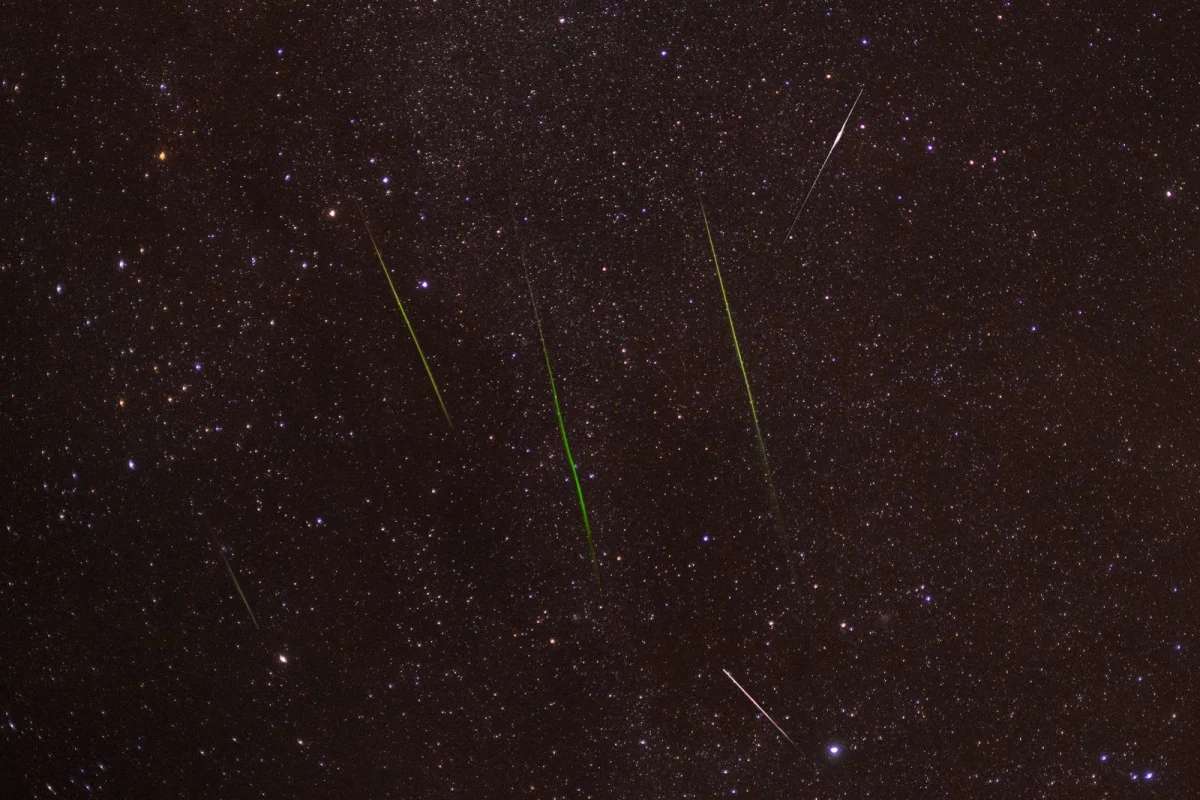
Table of contents
You drive 40 minutes out of town on the night of December 13, unfold a camp chair, and stare up for an hour. You count 22 meteors. Every headline promised 120. Did you pick the wrong night, or did the headlines oversell the Geminid meteor shower?
Neither, exactly. The 120 figure is real, but it describes a sky almost nobody gets to see. Once you know the two numbers that shrink it, you can predict your own count before you leave the house and pick the spot and hour that roughly doubles it.
This guide covers when the Geminids peak this year, why this shower comes from a rock instead of a comet, and the simple math that turns the advertised rate into the number you will actually see.
When the Geminid Meteor Shower Peaks This Year
NASA lists the Geminids as active from December 4 to December 17, with the peak on the night of December 13 to 14. EarthSky predicts the exact maximum at 5:44 UTC on December 14. That is 12:44 a.m. Eastern time and 9:44 p.m. Pacific time on the 13th, which puts the peak in the dark hours across North America.
In India the same moment falls at 11:14 a.m. on December 14, in daylight. The Geminid peak is broad, though, so Indian viewers still see strong rates on the nights of the 13th and 14th. If you are planning a watch party across cities, the time zone converter turns that UTC time into local time for everyone in the group.
The Moon is on your side
The American Meteor Society puts the Moon at 15% illuminated, a waxing crescent, on peak night. Royal Museums Greenwich says it sets around 9:20 p.m. in the UK. In practice that means the sky turns properly dark just as the Gemini radiant climbs, so you get the dark sky and the high radiant at the same time.
Why the Geminids Come From an Asteroid
Most meteor showers are comet dust. The Geminids are the odd one out. Their parent is 3200 Phaethon, a rocky object about 5.1 km across that NASA says loops around the Sun every 1.4 years. A satellite called IRAS discovered it on October 11, 1983, and the astronomer Fred Whipple later linked it to the December shower.
Phaethon swings very close to the Sun, and that heating appears to crack rock off its surface. Earth crosses the resulting debris trail every December. The grains are denser than comet dust, so they survive longer in the atmosphere and burn as slower, steadier streaks.
- Speed: about 35 km per second, according to NASA. That is slow next to the Leonids, so Geminids are easier to follow with your eye.
- Color: NASA describes them as yellow, and Royal Museums Greenwich notes they can look multicoloured.
- Radiant: near the bright star Castor in Gemini, though meteors can appear anywhere in the sky.
The Two Numbers That Shrink 120 Meteors an Hour
The headline figure is the zenithal hourly rate, or ZHR. It is a standardized count: what one observer would see in an hour if the radiant sat straight overhead and the sky was dark enough to show stars down to magnitude 6.5. That is a darker sky than most people have ever stood under.
Real conditions cut the count in two ways. First, the height of the radiant: when Gemini is low, half the meteor stream hits the atmosphere at a grazing angle you never see. Observers correct for this with the sine of the radiant's altitude. At 30 degrees you lose half the meteors. At 60 degrees you keep about 87%.
Second, sky brightness. Meteor observers use a population index, written r, that says how many more meteors appear each time you can see one magnitude fainter. A value of about 2.6 is commonly used for the Geminids. Every magnitude of sky glow you lose divides your count by roughly 2.6.
The formula, in plain words
Your expected count equals the ZHR, times the sine of the radiant's altitude, divided by 2.6 for every magnitude your sky falls short of 6.5. Clouds, trees and a narrow view of the sky cut it further.
Worked Example: Your Real Geminid Count
Take the NASA figure of 120 and assume you watch around 2 a.m., when EarthSky says the radiant is highest. From 40 degrees north, Gemini climbs to about 80 degrees at its highest, so call it 60 degrees for a typical hour around the peak. The sine of 60 degrees is 0.87.
- Truly dark site (stars to magnitude 6.5): 120 x 0.87 = about 104 meteors an hour.
- Rural site (magnitude 6.0): 104 divided by 1.61 = about 65 an hour.
- Suburban backyard (magnitude 5.0): 104 divided by 4.19 = about 25 an hour.
- City center (magnitude 4.0): 104 divided by 10.9 = about 10 an hour.
Now change the hour instead of the place. At 10 p.m. the radiant is nearer 30 degrees, and the sine drops to 0.5. The same suburban backyard now gives 120 x 0.5 divided by 4.19, or about 14 an hour. Waiting until after midnight nearly doubles your count without moving an inch.
That 40-minute drive from the opening scenario? It most likely took you from a magnitude 5 sky to something near magnitude 6, which lifts your expected rate from about 25 to about 65. Count 22 in a bright suburb and you did exactly as well as the math said you would.
How to check your sky's limiting magnitude
Find the Little Dipper. If you can see only the two brightest stars of its bowl, your sky is near magnitude 3 or 4. If you can see all seven stars clearly, you are close to magnitude 5. If the faint Milky Way band is obvious overhead, you are at 6 or better.
Where You Live Changes the Geminid Show
Gemini sits high in the northern sky, so latitude matters. For northern viewers, the radiant's highest point is roughly 90 minus your latitude plus 32 degrees, capped at straight overhead.
- New York or Madrid (about 40 degrees north): the radiant peaks near 82 degrees, almost overhead.
- London (51.5 degrees north): about 70 degrees, still excellent.
- Mumbai (19 degrees north): the radiant tops out near 77 degrees, so rates are strong if you escape the city glow.
- Sydney (34 degrees south): the radiant only reaches about 24 degrees, which cuts the count by more than half. Southern viewers see far fewer Geminids.
A Simple Plan for Peak Night
The setup matters more than gear. You do not need a telescope or binoculars, which actually narrow your view.
- Pick the darkest site within an hour's drive. Each magnitude of darker sky multiplies your count by about 2.6, so distance from lights beats every other choice.
- Go out after the Moon sets. This year that is mid evening, and the best rates run from midnight to dawn.
- Give your eyes 30 minutes. NASA recommends this to adjust to the dark. One glance at a phone screen resets the clock, so use a red light.
- Lie back and look about 45 degrees up, slightly away from Gemini. Meteors near the radiant look short. Ones farther away draw longer trails.
- Dress for hours, not minutes. NASA suggests a sleeping bag or a reclining chair. December nights in the north drop below freezing.
Two more sky events right after
The American Meteor Society lists the Ursids from December 17 to 26, peaking on the night of December 21 to 22. Expect only 5 to 10 per hour, and an 89% Moon will wash out most of them. Then on Christmas Eve comes the closest full moon of the year, about 356,740 km away according to Fred Espenak's tables as cited by EarthSky. Big full moons also pull higher tides, which we explain in our piece on king tides and the supermoon.
Frequently Asked Questions
What time is the Geminid meteor shower tonight?
Meteors start once Gemini rises in the early evening, but the best rates come after midnight local time, with the radiant highest around 2 a.m. The predicted peak is 5:44 UTC on December 14. The nights of December 12 to 13 and 14 to 15 are also worth a look.
How many Geminid meteors can you see per hour?
Up to 120 per hour under perfect skies, according to NASA, but most people see far fewer. Expect around 60 to 70 from a dark rural site after midnight, about 25 from a suburb, and 10 or fewer from a city center.
Can you see the Geminids from the city?
Yes, but only the brightest ones. The worked math above suggests about 10 an hour from a city center, and Geminids are known for bright streaks, so you will still catch some. Face away from the brightest lights and give your eyes at least 20 minutes.
Do you need a telescope to see the Geminid meteor shower?
No. Meteors cross large parts of the sky in under a second, and a telescope or binoculars show only a tiny patch of it. Your naked eyes, a wide view of the sky, and patience work best.
Why is the Geminid meteor shower so bright?
Its debris comes from the rocky asteroid 3200 Phaethon rather than an icy comet. Those denser grains hit the atmosphere at a moderate 35 km per second and burn longer, which produces bright, slow, often colorful streaks.
Plan Your Geminid Night Around the Math
The Geminid meteor shower is the strongest of the year, and this December the Moon gets out of its way early. The advertised 120 per hour is a ceiling, not a promise. Your real number depends on how dark your sky is and how high Gemini sits when you look.
So pick the darkest spot you can reach, go out after midnight on December 13 to 14, and lie back for at least an hour. Run the numbers first and you will know exactly what a good night looks like. If you enjoy watching the sky change, our story on how NASA still hears Voyager 1 at one light-day shows how far that same sky reaches.
Written by
Nora Whitfield
Technology & Science
Covers technology and science for Quick Trend Insights, with a focus on what new AI tools, consumer hardware and space missions actually change for the people following them.
Related Articles
View all
Starship Catch: Why Catching the Upper Stage Matters
The Starship catch on Flight 15 brought an upper stage home from orbit for the first time. See why it is so hard, what it costs, and what must happen next.
Asteroid Deflection: What Hera Found After DART
Hera found a stadium-sized DART crater on Dimorphos. Learn why the impact moved it four times more than expected and what that means for asteroid deflection.

King Tides and the Supermoon: Why Coasts Are Flooding
King tides and a supermoon are flooding US coasts before Thanksgiving. See what causes them, why flooding is rising, and how to prepare at home or on the road.