
Asteroid Deflection: What Hera Found After DART
Hera found a stadium-sized DART crater on Dimorphos. Learn why the impact moved it four times more than expected and what that means for asteroid deflection.
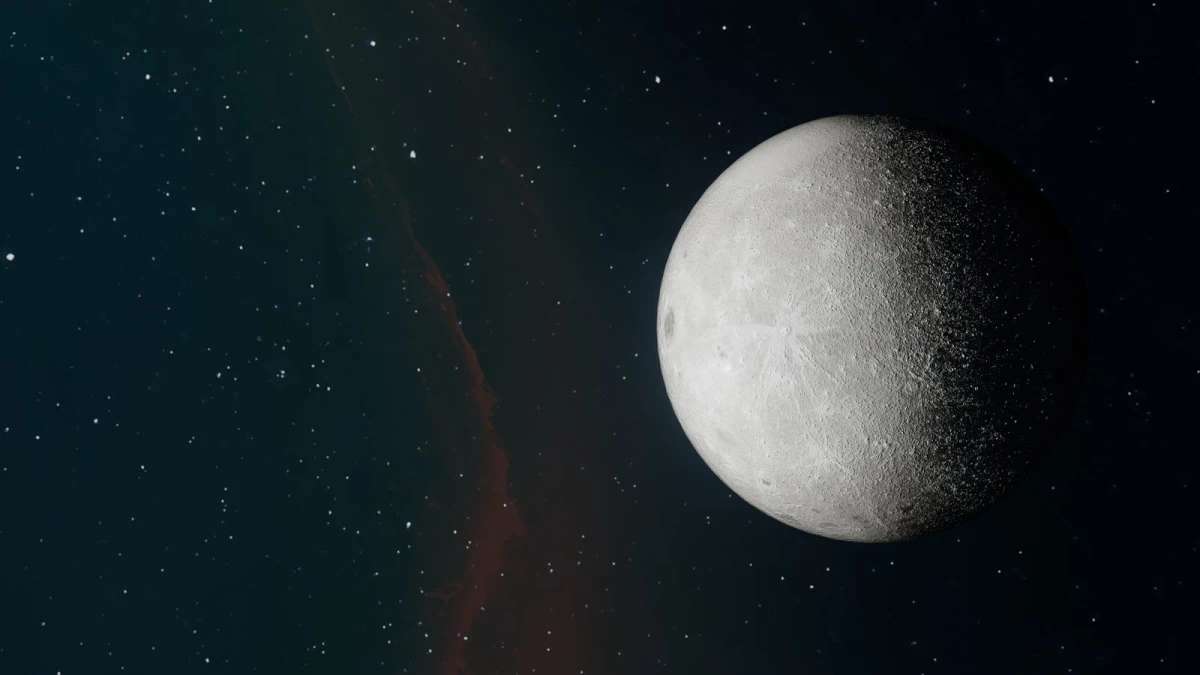
Table of contents
Imagine astronomers spot a 150 meter asteroid on a path that crosses Earth's orbit a decade from now. You would want two answers fast. Can we push it aside, and how hard do we need to hit it? For years the honest reply to the second question was a shrug. On November 25, Europe's Hera spacecraft sent back pictures that make asteroid deflection far less of a guess.
Hera has been studying Dimorphos, the small moon that NASA's DART spacecraft rammed in September 2022. The first close-ups show a crater the size of a sports stadium stretching across the whole asteroid, one face flattened, and the moon now tumbling in its orbit.
Here is what Hera found, why the impact moved Dimorphos about four times more than the crash alone should have, and the worked math that shows what this means for defending Earth.
What Hera Found at Dimorphos
Dimorphos is about 151 meters across and orbits a larger asteroid, Didymos, which is about 730 meters wide. ESA says the pair is currently 193.5 million km from Earth. Hera is studying them from 25 to 30 km away, moving at a gentle 12 cm per second along rectangular paths set by short thruster firings.
Before arrival, scientists argued over three outcomes. DART might have left a clean crater. It might have reshaped the whole asteroid, as a 2024 simulation study mentioned by ESA suggested. Or Dimorphos might look about the same. "Much to our surprise the answer turns out to be all three at once!" said Patrick Michel, Hera's principal investigator.
- A stadium-sized crater: it spans the asteroid's entire width and has flattened one face, according to ESA.
- A tumbling moon: mission scientist Michael Kueppers said the impact "has left Dimorphos tumbling wildly in its orbit."
- Hundreds of boulders: rocks a few meters wide now orbit the pair, and the team must plan around them as Hera moves closer.
- Sharp images: one released frame was shot on November 7 from 29 km at 2.7 meters per pixel, Popular Science and Astronomy Now reported.
Why DART Moved the Asteroid Four Times More Than Expected
DART weighed about 580 kg and hit at roughly 6.1 km per second on September 26, 2022. If the spacecraft's momentum had simply been absorbed, the moon's orbit of just under 12 hours should have shrunk by about 7 minutes. Instead, a team writing in Nature measured a cut of 33.0 minutes, give or take 1 minute.
The difference comes from the debris. When DART struck, it blasted a huge plume of rock off the surface. That rock flew backward, toward the direction DART came from. Every kilogram thrown backward pushed Dimorphos forward a little more, the same way a gun kicks back when it fires.
Beta, the number planetary defense hangs on
Scientists call that boost the momentum enhancement factor, or beta. A beta of 1 means the target absorbed only the spacecraft's own momentum. A second Nature paper, led by Andrew Cheng, estimated beta at 3.61 if Dimorphos has a density of 2,400 kg per cubic meter. In other words, the flying debris supplied well over half of the total shove.
The weak point is that density. The same paper gives beta anywhere from 2.2 to 4.9 across plausible densities from 1,500 to 3,300 kg per cubic meter. Nobody has weighed Dimorphos yet. Hera will, and that single measurement turns a wide range into one number future missions can design around.
Worked Example: The Asteroid Deflection Math
You can rebuild DART's result with a calculator. Treat Dimorphos as a sphere for simplicity, even though Hera shows it is not one.
- DART's momentum: 580 kg x 6,100 m/s = about 3.54 million kg meters per second.
- Dimorphos's volume: a 151 meter sphere has a radius of 75.5 meters, so the volume is about 1.8 million cubic meters.
- Dimorphos's mass: at 2,400 kg per cubic meter, that is about 4.3 billion kg.
- Push with no debris (beta of 1): 3.54 million divided by 4.3 billion = about 0.82 millimeters per second.
- Push with debris (beta of 3.61): 0.82 x 3.61 = about 2.96 millimeters per second.
Cheng's team measured an instant change of 2.70 millimeters per second along the moon's orbit. Your rough answer lands within about 10% of it, and the gap comes from the sphere shortcut and the angle of impact. Three millimeters per second is slower than a snail. It is also enough to change an orbit.
What a few millimeters per second buys you
Now apply that nudge to an asteroid headed for Earth. Keep the math simple and let the 2.7 mm per second change act for 10 years in a straight line. Ten years is about 315 million seconds, so the asteroid ends up roughly 850 km from where it would have been.
Earth's radius is about 6,371 km, so 850 km would not be enough on its own. Real orbital mechanics helps, because a change in speed also changes the orbital period and the drift grows over every lap. Still, the lesson holds: warning time multiplies a small push. A hit 20 years ahead does at least twice the work of the same hit 10 years ahead.
Why the Tumbling and Boulders Matter
A tumbling asteroid is harder to model than a neatly spinning one. Its shape now presents a changing face to Didymos, and that alters the tiny gravitational tugs between the two. Hera's tracking will show whether the orbit keeps settling or stays erratic.
The boulders tell a different story. Astronomy Now described them as ranging from football to washing machine size, and their origin is not settled. They could be debris from DART or rock shed by the fast-spinning Didymos. Either way, an asteroid that sheds this much material when hit is a loose rubble pile, not a solid rock. Rubble piles absorb and throw off impacts differently, which is exactly why the density number matters so much.
What Hera Does Next
ESA says Hera will move in to about 13 km in December for sharper images. In January it will release two shoebox-sized CubeSats.
- Juventas, led by Luxembourg, will use low-frequency radar to look inside an asteroid for the first time, then attempt a landing.
- Milani, led by Italy, will study the surface material and the dust around the pair.
The bigger test comes in April 2029, when the asteroid Apophis passes about 32,000 km above Earth's surface, inside the ring of many geostationary satellites. ESA and Japan's space agency are preparing a mission called Ramses to study it. Long-haul missions like this reward patience, as our story on why BepiColombo took eight years to reach Mercury shows. Talking to probes this far out is its own challenge, explained in our piece on how NASA still hears Voyager 1.
Frequently Asked Questions
How big is the DART crater on Dimorphos?
ESA describes it as the size of a sports stadium. It stretches across the full width of Dimorphos, which is about 151 meters wide, and it has flattened one face of the asteroid. Exact dimensions will come as Hera moves closer.
Did the DART mission work?
Yes. DART shortened Dimorphos's orbit around Didymos by about 33 minutes, far more than the roughly 7 minutes expected from the spacecraft's momentum alone. It showed that a kinetic impactor can change an asteroid's path.
Could we stop an asteroid from hitting Earth?
For a small or medium asteroid found years in advance, a DART-style impact looks workable. The push is small, a few millimeters per second, so success depends on finding the threat early and knowing the asteroid's mass and structure.
What is the Hera mission?
Hera is a European Space Agency spacecraft built by an 18-nation consortium led by the German firm OHB. It is surveying Didymos and Dimorphos to measure the DART crater, the moon's mass and its interior, so future deflection missions can be sized properly.
Asteroid Deflection Just Got a Real Data Point
DART showed that you can move an asteroid. Hera is showing what the hit did to the rock: a stadium-sized scar, a reshaped face, a tumbling orbit, and a cloud of boulders. Most of all, it is about to weigh Dimorphos, which pins down the beta factor that every future asteroid deflection plan depends on.
Keep an eye on Hera's closer pass in December and the CubeSat landings early next year. The next time someone asks whether we could knock a dangerous asteroid aside, the answer will rest on measured numbers rather than models.
Written by
Nora Whitfield
Technology & Science
Covers technology and science for Quick Trend Insights, with a focus on what new AI tools, consumer hardware and space missions actually change for the people following them.
Related Articles
View all
Starship Catch: Why Catching the Upper Stage Matters
The Starship catch on Flight 15 brought an upper stage home from orbit for the first time. See why it is so hard, what it costs, and what must happen next.
Geminid Meteor Shower: How Many You'll Really See
The Geminid meteor shower peaks December 13 to 14. See why 120 an hour is a ceiling and use simple math to predict your real count from your own night sky.

King Tides and the Supermoon: Why Coasts Are Flooding
King tides and a supermoon are flooding US coasts before Thanksgiving. See what causes them, why flooding is rising, and how to prepare at home or on the road.