
BepiColombo Mercury Orbit: Why It Took 8 Years
The BepiColombo Mercury orbit took eight years and nine flybys to reach. Here is why, what its two orbiters will study, and what is new since MESSENGER.
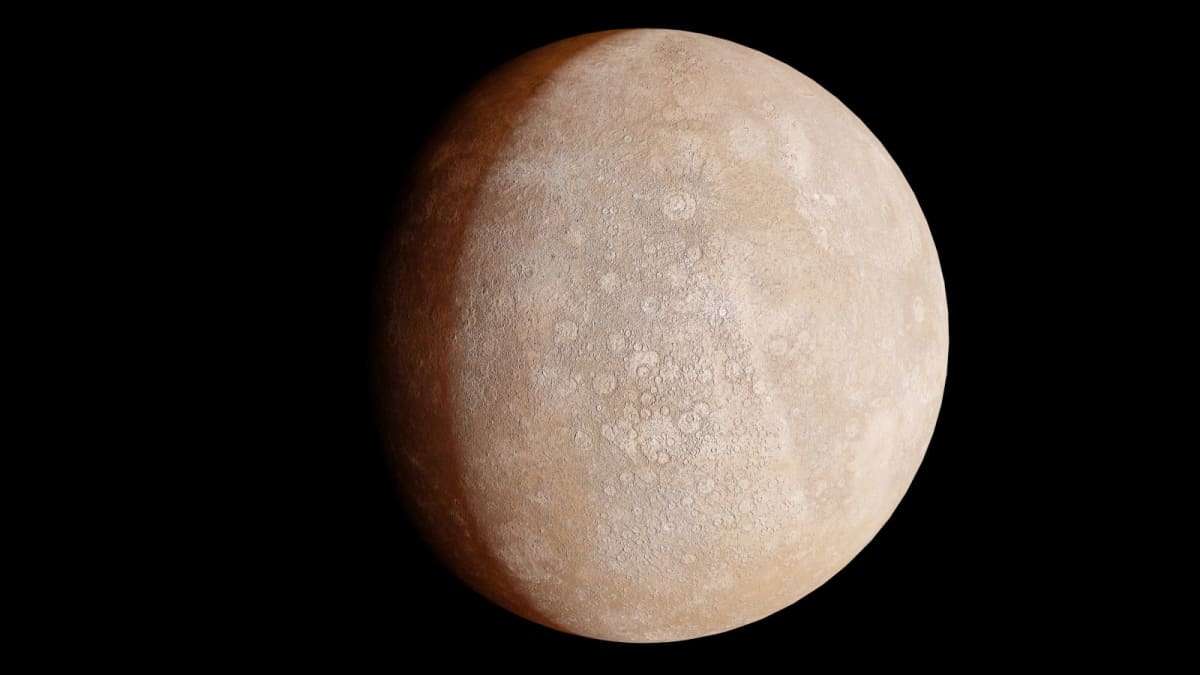
Table of contents
Look at a map of the solar system and Mercury seems like the easy trip. It is the closest planet to the Sun, a fraction of the way to Jupiter or Saturn. Yet the BepiColombo Mercury orbit arrival on November 21 came more than eight years after launch, after nine planetary flybys and billions of kilometers of looping travel.
BepiColombo is a joint mission between the European Space Agency (ESA) and the Japan Aerospace Exploration Agency (JAXA). It is only the second spacecraft ever to orbit Mercury. Here is why getting there took so long, what its two orbiters will study, and what they can see that NASA's MESSENGER could not.
Why the BepiColombo Mercury Orbit Took Eight Years
Your intuition says that heading toward the Sun is "downhill," so it should be cheap. In one sense it is. A spacecraft falling inward picks up speed the whole way, the way a ball speeds up rolling down a slope.
That is the problem. To stay at Mercury, you have to arrive slow enough to be caught, and Mercury has weak gravity. NASA's planetary fact sheet lists its escape velocity at just 4.3 km/s, less than half of Earth's. Anything arriving much faster than that relative to the planet simply flies past.
Worked example: the speed gap
Use NASA's own orbital figures to see the size of the job:
- Earth circles the Sun at about 29.8 km/s, at 149.6 million km out.
- Venus moves at about 35.0 km/s, at 108.2 million km.
- Mercury moves at about 47.4 km/s, at only 57.9 million km.
So Mercury travels 17.6 km/s faster than Earth around the Sun. You might think a probe just needs to "catch up." But a probe that simply falls inward from Earth picks up so much speed on the way down that it reaches Mercury's distance moving several kilometers per second faster than the planet, on a stretched orbit that whips straight past it. Engineers have to remove that extra energy somewhere between Earth and Mercury.
ESA puts it bluntly: entering orbit at Mercury takes more energy than a mission to Pluto. A Pluto probe can coast for years once it is moving. A Mercury probe has to keep braking against the Sun's pull. Hauling enough fuel to brake with rockets alone would make the launch mass impractical, so the mission planners borrowed braking from the planets instead.
Nine Flybys and an Ion Engine: The Long Way In
A gravity assist trades momentum between a spacecraft and a planet. Pass behind a planet in its orbit and you gain speed. Pass in front and you lose some. BepiColombo used flybys mostly to lose energy and gradually shrink its path around the Sun until it matched Mercury's.
ESA's mission factsheet lists the full sequence:
- Earth flyby in April 2020.
- Two Venus flybys, in October 2020 and August 2021.
- Six Mercury flybys, from October 2021 through January 2025.
Each Mercury pass trimmed the speed difference a little more. Between passes, the Mercury Transfer Module fired its electric thrusters for long stretches. Ion engines push gently but run for months, which suits a slow spiral inward.
The delay that added a year
The plan originally targeted December 2025. In 2024 a power fault in the transfer module stopped its electric thrusters from running at full strength, according to reporting by Space.com and Eos. Mission teams redesigned the route, and arrival slipped to November. JAXA published its own notice of the changed arrival time.
For comparison, NASA's MESSENGER took a similar long road. ESA's science portal says it travelled 7.9 billion km, including 15 trips around the Sun, before entering orbit in March 2011.
What Happened on November 21
The transfer module separated on September 3. ESA confirmed that through its deep space antennas in Cebreros, Spain, and Malargüe, Argentina, when the spacecraft was more than 200 million km from Earth. From then on, the European orbiter's own solar panels powered the stack.
On November 21, the still-joined orbiters fired their thrusters to slow down enough for Mercury to capture them. Space.com reported that the main burn was scheduled to start at 18:24 GMT and last 37 minutes. Eos reported the pair entered an elliptical orbit that day. If you want to see what 18:24 GMT was where you live, a time zone converter does it in a second.
The arrival is a sequence, not a single moment
- December 9 to 10: ESA's Mercury Planetary Orbiter (MPO) and JAXA's Mio separate. Mio then heads into its own long, elliptical polar orbit.
- December 16: the sunshield and interface structure that protected Mio separates from the MPO, per ESA.
- Through March: the MPO fires a series of 16 burns, which ESA says will lower it into its final orbit around March 10.
- April 6: science operations begin, according to Space.com and ESA's schedule.
ESA notes that exact dates can shift for operational reasons. The planned science phase is one Earth year, which equals about four Mercury years, with an optional one-year extension.
What BepiColombo Will Study
Mercury is small, dense and odd. ESA says it spins three times for every two trips around the Sun, so one solar day there lasts 176 Earth days. Daytime surface temperatures climb past 400°C, yet radar and neutron data show water ice sitting in permanently shadowed polar craters.
The Mercury Planetary Orbiter (ESA)
The MPO carries 11 instruments aimed at the surface and interior. Eos lists the main jobs:
- Mapping the heavily cratered surface and its geology with cameras.
- Measuring composition and temperature with spectrometers.
- Building a height map with the BELA laser altimeter, which ESA says fired more than 700,000 test pulses in September.
- Weighing the core with a radio science experiment and an accelerometer that track tiny changes in the orbit.
Mio, the magnetospheric orbiter (JAXA)
Mio carries 5 instruments and spins 15 times a minute. JAXA says it will study Mercury's magnetic field, plasma, thin atmosphere and dust. The field is a real puzzle. It is about 100 times weaker than Earth's, and its center sits roughly 484 km north of the equator, according to ESA. Scientists still cannot fully explain how such a small planet keeps a working magnetic dynamo.
What's New Compared With MESSENGER
MESSENGER orbited Mercury from 2011 to 2015 and made huge discoveries, including the ice and that offset magnetic field. Its orbit, though, had a built-in blind spot.
Orbit shape decides what you can see
ESA's science portal gives MESSENGER's orbit as 200 km by about 15,193 km, with its low point above 60 degrees north. It saw the northern hemisphere in fine detail and the south only from far away. BepiColombo's MPO will fly a much rounder 480 by 1,500 km polar orbit, which keeps the whole planet within close range.
- Spacecraft in orbit: MESSENGER had 1. BepiColombo has 2.
- Instruments: MESSENGER carried 7. BepiColombo carries 11 on the MPO and 5 on Mio.
- Orbit: MESSENGER flew 200 by 15,193 km. The MPO flies 480 by 1,500 km and Mio 590 by 11,640 km.
- Time in orbit: MESSENGER ran from 2011 to 2015. BepiColombo starts science in April with one year planned.
Two spacecraft at once
JAXA calls two orbiters working at Mercury simultaneously a world first. One spacecraft alone cannot tell whether a change in the magnetic field comes from inside the planet or from a gust of solar wind. With Mio watching the space around Mercury while the MPO measures closer in, scientists can separate the two. That matters because the solar wind at Mercury is far stronger than at Earth.
Missions like this are also part of a wider commercial and scientific push beyond Earth. Our look at the space economy covers who pays for that work, and robots that build in orbit shows where spacecraft hardware is heading next.
Frequently Asked Questions
Why did BepiColombo take so long to reach Mercury?
A spacecraft falling toward the Sun speeds up, and Mercury's gravity is too weak to catch a fast probe. BepiColombo spent about eight years using nine flybys and electric thrusters to slow down enough to enter orbit.
When does BepiColombo start science at Mercury?
Science operations are scheduled to begin in April, after the two orbiters separate in December and the MPO reaches its final orbit around March 10. ESA says exact dates may shift.
What is the difference between BepiColombo and MESSENGER?
MESSENGER was one NASA spacecraft with 7 instruments on an orbit that favoured the northern hemisphere. BepiColombo is two spacecraft with 16 instruments between them, and the MPO's lower, rounder orbit covers the whole planet more evenly.
Why is it harder to reach Mercury than Pluto?
ESA says orbiting Mercury needs more energy than a Pluto mission because the probe must cancel the speed it gains falling toward the Sun. A Pluto probe can coast once launched, while a Mercury probe has to keep braking.
A Long Brake Pays Off
BepiColombo's eight-year trip was never about distance. It was about speed, and about patiently using Venus, Mercury and gentle ion thrust to undo the pull of the Sun. The reward is two orbiters at the least explored rocky planet, set up to map its surface, weigh its core and explain its lopsided magnetic field.
The next milestone is the December separation, then science from April. Watch our science and space coverage for the first results.
Written by
Nora Whitfield
Technology & Science
Covers technology and science for Quick Trend Insights, with a focus on what new AI tools, consumer hardware and space missions actually change for the people following them.
Related Articles
View all
King Tides and the Supermoon: Why Coasts Are Flooding
King tides and a supermoon are flooding US coasts before Thanksgiving. See what causes them, why flooding is rising, and how to prepare at home or on the road.