
In-Space Assembly: Why a Robot Building in Orbit Matters
In-space assembly had its first real test: a Caltech robot built part of an antenna in orbit alone. Here is why size limits matter for your phone and more.
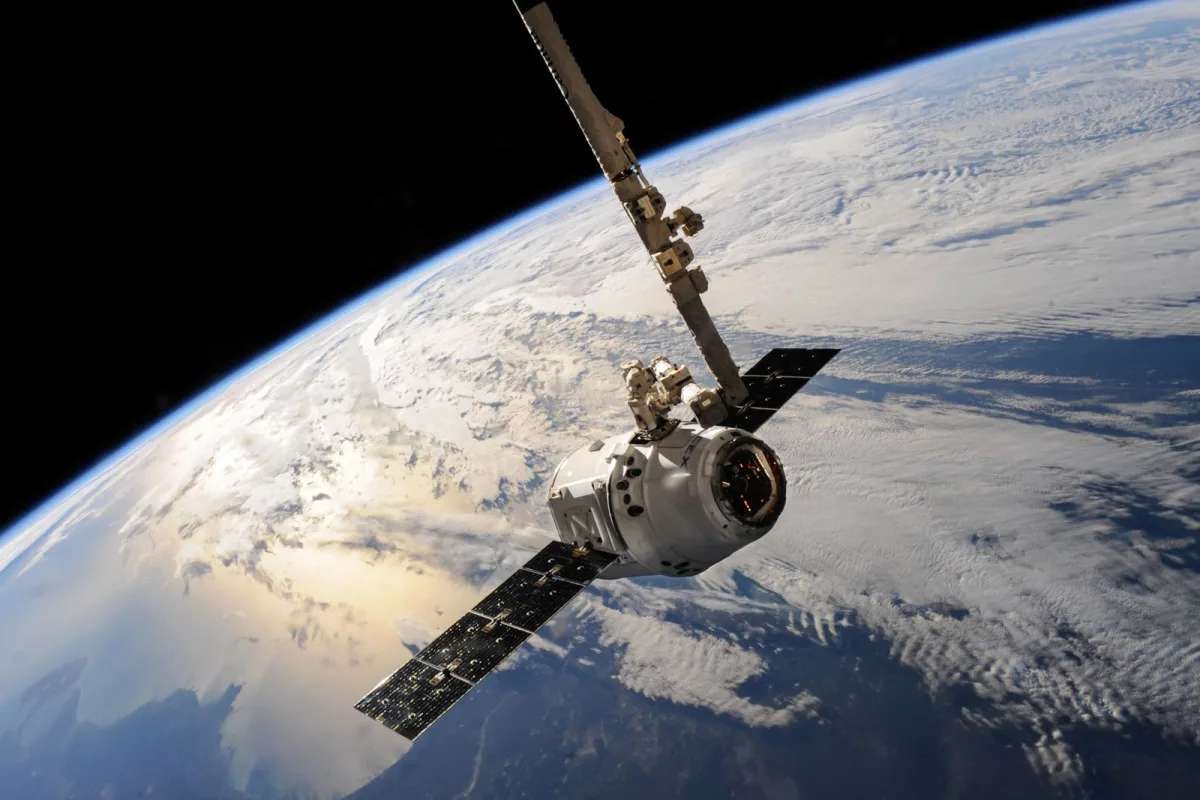
Table of contents
Picture the biggest thing you could ever send to space. It has to fit inside the nose cone of a rocket, a shell only a few meters wide. Every satellite, telescope and antenna in orbit today obeys that limit. That is why in-space assembly, a robot building the structure after launch instead of on the ground, matters more than one small demo might suggest.
In early November, Caltech said its ASTRA robot had done something no machine had done before. It built part of a structure in orbit, on its own, with no astronaut nearby. It did not finish the job. But the way it failed and the way it worked both tell you a lot about what your phone signal, your weather forecast and future clean power could look like.
This guide covers what ASTRA built, why rocket size caps nearly everything in orbit, the math that makes size so valuable, and a realistic read on timing.
What the ASTRA Robot Actually Built in Orbit
ASTRA stands for Autonomous In-Space Tensioned Reflector Assembly. It launched on March 30 from Vandenberg Space Force Base, riding on a Momentus Vigoride vehicle that flew on SpaceX's Transporter-16 rideshare mission. The whole package took up about one cubic meter, roughly the size of a washing machine.
According to the Caltech news release, the target was a reflector antenna 1.4 meters across, made of 11 repeating sections called bays. The process works like a tiny factory line:
- A robotic arm picks up struts and joints from small motorized dispensers.
- It sets the parts in place on an assembly plate and joins them into one bay.
- It attaches a perforated reflective film, which forms two cable nets held tight against each other by springs.
- It pushes the finished bay out into space and starts the next one.
The payload flew with two bays prebuilt. In orbit, the robot built a third. That was as far as it got before the team ran short of time, and the mission is set to end in December.
So the honest score is one bay built in space out of nine planned. The project lead, Sergio Pellegrino of Caltech and NASA's Jet Propulsion Laboratory, still called it the first structure ever constructed autonomously in space. A first is a first, even when it is small.
Why one bay still counts
Every hard step happened at least once: pick, place, join, tension, push out. Engineers now know which of those steps went wrong in real microgravity, and they have a list of design changes. That data is the real product of a first flight.
Why Rocket Size Caps Almost Everything in Orbit
Every payload rides to orbit inside a fairing, the protective nose cone at the top of a rocket. Whatever you launch must fit inside it. That single rule shapes the design of nearly every large object in space.
Engineers have had two ways around it. Fold it, or bolt it together by hand. Folding means packing a structure tight and trusting a chain of hinges, springs and motors to open it in orbit. Bolting means sending pieces up on several launches and having astronauts assemble them, which is how the International Space Station was built.
The James Webb Space Telescope shows how far folding can be pushed. NASA says its primary mirror is 6.5 meters across, made of 18 hexagonal segments. That is wider than the rocket that carried it, so the two side wings of the mirror folded back like a drop-leaf table for launch.
Folding works, but it does not scale forever. Each extra hinge is one more part that has to work perfectly, once, far from any repair crew. And a structure hundreds of meters wide cannot be folded into a 5-meter shell at all.
The third option: launch parts packed densely as raw stock, then let a robot assemble them in orbit. No folding limit, no astronaut needed, and the size of the finished structure is set by how many parts you send, not by the width of the rocket.
The Math That Makes In-Space Assembly Worth It
Why chase size at all? Because the useful power of an antenna or a mirror grows with its area, and area grows with the square of the diameter. Double the width and you get four times the surface to catch light or radio signals.
Run the numbers on real hardware and the scale gap jumps out.
- ASTRA's demo reflector: 1.4 meters across, so about 1.5 square meters of area (0.7 × 0.7 × 3.14).
- Hubble vs. Webb: NASA gives Hubble's mirror as 2.4 meters and Webb's as 6.5 meters. The diameter ratio is about 2.7, so the area ratio is roughly 7.3 times.
- A phone-signal satellite: AST SpaceMobile's first BlueBird satellites carry 8-by-8-meter arrays, or 64 square meters. Its next generation is about 2,400 square feet, close to 223 square meters, according to Spaceflight Now.
- A 100-meter dish: 50 × 50 × 3.14 is about 7,850 square meters. That is roughly 35 times the newest BlueBird array and over 5,000 times ASTRA's demo.
AST SpaceMobile's CEO told Spaceflight Now that a 7-meter fairing offers twice the payload volume of 5-meter class rockets. Even that bigger shell lets Blue Origin fit up to eight of the new satellites per flight, and each still has to unfold.
The 100-meter dish above is not on any company's roadmap. It is the scale DARPA names, though. Andrew Detor, who runs DARPA's program, said the aim is structures hundreds of meters or kilometers in size. No fold pattern gets you there. Assembly does.
Why the Robot Has to Think for Itself
One detail makes ASTRA an AI and robotics story rather than only a space story. The team on the ground could talk to it during seven or eight windows a day, each about 15 minutes long.
That is at most 120 minutes of contact in a 24-hour day. For the other 22 hours, the robot was on its own. It could not wait for a person to check each joint before moving to the next one.
When something went wrong, the team used a twin on the ground. A flight spare sat in the Caltech lab, so engineers could reproduce a fault on the ground, test a fix, and then upload the workaround in the next window. One former team member put it simply: there are always lots of little surprises.
This is the same problem facing robots on Earth. A warehouse or humanoid robot working in a real building meets parts that are slightly off, grips that slip, and lighting that changes. Space adds vacuum, temperature swings and a 15-minute leash. Software that handles small surprises without a human is the hard part in both places, and it is why research into AI that learns physics before it acts keeps drawing money.
What In-Space Assembly Could Mean for You
None of this changes your life next month. But the uses Caltech lists map straight onto things you already pay for or depend on.
Stronger satellite signal on an ordinary phone
Your phone has a tiny antenna and very little transmit power. For a satellite hundreds of kilometers up to hear it, the satellite has to make up the difference with a huge antenna. That is why direct-to-phone satellites keep getting bigger arrays. Building larger antennas in orbit, instead of folding them, is one path to better coverage where towers do not reach, such as on hikes, at sea or after storms.
Sharper telescopes and weather data
Bigger mirrors see fainter and finer detail. The same holds for radar and radio instruments that watch weather, crops and sea ice. Larger apertures mean sharper data, which feeds forecasts and insurance models.
Power beamed from orbit
Caltech also names very large solar arrays for space solar power. This idea needs structures far bigger than anything a rocket can carry whole. It is the furthest off of the three, and it depends on assembly working at scale first.
If you follow the money side, our look at the space economy and where investors are betting covers the companies chasing these markets. Treat any pitch that leans on in-orbit construction as early-stage, because the first demo built one bay.
A Realistic Timeline for Robots Building in Orbit
Keep three facts in view when you read the next headline.
- The demo was small. One bay of a 1.4-meter antenna is a proof of concept, not a product.
- The program is still a research effort. DARPA's NOM4D program is in its third phase, and only two projects reached it: Caltech's and one from the University of Illinois Urbana-Champaign, which is testing carbon tube hardening aboard the space station.
- The build was fast. The Caltech team had less than 12 months to build and deliver the flight hardware, which says the method can iterate quickly once the design is fixed.
The likely next steps are a second flight with the design fixes, then a full reflector, then larger trusses. The first commercial uses will probably be antennas, since they are the most direct path from bigger area to more revenue.
Folding will not disappear either. Webb proved how much it can do, and companies like AST SpaceMobile are shipping folded arrays today. Expect the two methods to coexist for years, with assembly taking over only where size makes folding impossible.
Frequently Asked Questions
What is in-space assembly?
In-space assembly means building a structure after it reaches orbit, instead of launching it fully built. Parts travel packed tightly, and a robot or astronaut joins them in space. It lets engineers make structures larger than any rocket could carry whole.
Did a robot really build something in space by itself?
Yes, on a small scale. Caltech's ASTRA robot built one truss bay of a planned antenna in orbit without human hands, after launching with two bays prebuilt. It did not finish the full 11-bay structure before time ran out.
Why can't satellites just be built bigger on Earth?
Anything launched whole must fit inside the rocket's fairing, which is only a few meters wide. Larger structures must fold to fit, and folding gets riskier and less practical as size grows. Past a certain size, building in orbit is the only option.
Will in-space assembly improve phone service from satellites?
It could over time. Satellites that talk directly to ordinary phones need very large antennas to pick up weak phone signals. Building those antennas in orbit could allow bigger arrays than folding allows, though no commercial service uses robotic assembly yet.
The Bottom Line
A robot about the size of a washing machine built one small piece of an antenna in orbit, mostly on its own. That sounds modest, and in raw size it is. What it proves is that the rocket's nose cone no longer has to set the upper limit on what we put in space.
Watch for the follow-up flight and a complete reflector. When robots can finish a full structure without help, the conversation shifts from whether in-space assembly works to how big it can go. Your phone signal, your forecasts and maybe your power bill sit somewhere down that line.
Written by
Nora Whitfield
Technology & AI
Covers the technology beat for Quick Trend Insights, with a focus on what new AI tools and consumer hardware actually change for the people using them.
Related Articles
View all
AI Meeting Assistant Now Acts Mid-Call: What Changes
An AI meeting assistant can now join your call and build the plan as you talk. What Claude Meetings does, the consent risks, and the math on time it saves.

AlphaGenome 2: What It Means for Your DNA Test
AlphaGenome 2 predicts how a DNA change acts inside one cell type. Here is what DeepMind's new model can and cannot tell you about your genetic test results.
Frontier AI Safety Laws Get Teeth: What Changes for You
Frontier AI safety laws could soon carry daily fines up to $3 million and outside audits. See what New York and Australia propose and what it means for users.