
Christmas Tree Care: Why a Dry Tree Burns in Seconds
Christmas tree care that prevents fires: how big a stand you need, why a fresh cut matters, what NIST tests show about dry trees, and when to take it down.
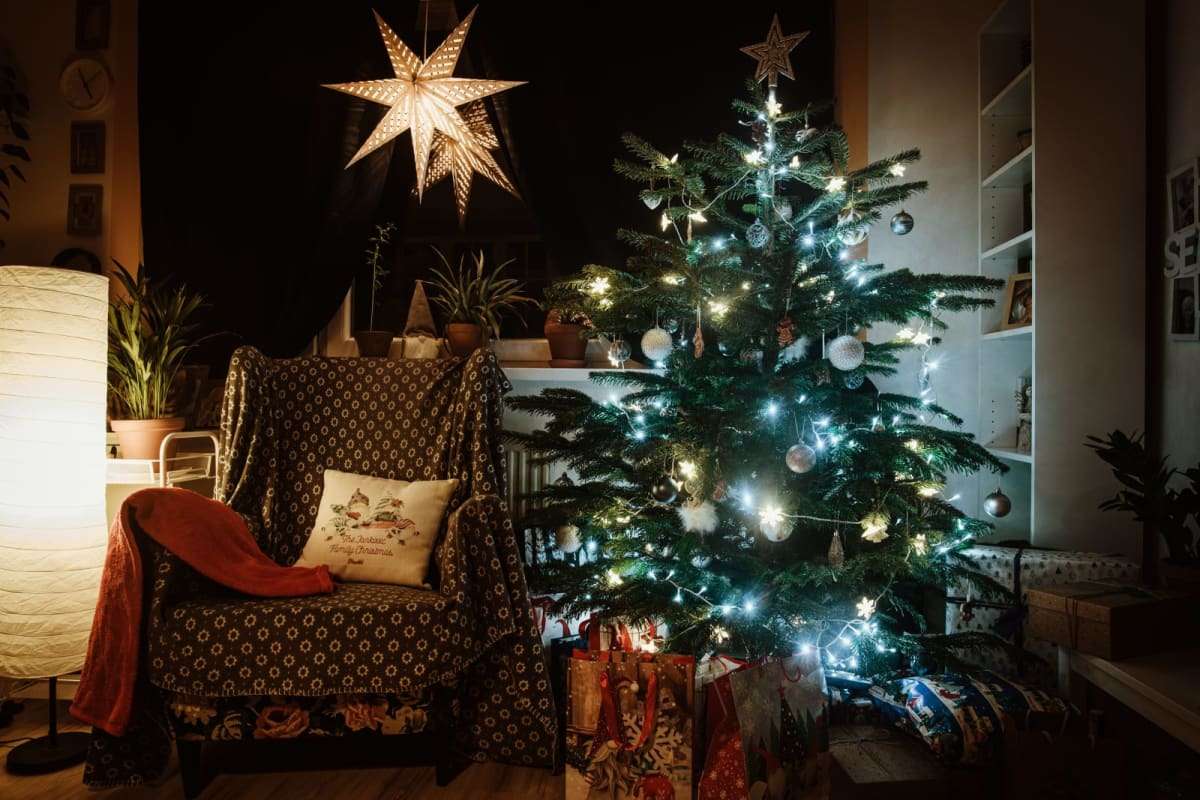
Table of contents
You haul a fresh fir home on the Saturday after Thanksgiving, wrestle it into the stand, and spend the evening on lights. Two weeks later you kneel down to check the water and find the bowl bone dry. You have no idea how long it has been that way. Christmas tree care comes down to that bowl, and it decides more than whether the needles land on your rug.
Fire researchers have filmed what a dry tree does when it meets a flame, and the numbers are hard to forget. The good news is that the fix is cheap and boring: the right stand, one fresh cut, and a daily look at the water line. This guide covers each step and the reasons behind it.
What a Dry Tree Does in a Fire
The National Institute of Standards and Technology has burned Christmas trees on purpose for years. In one comparison, a dry Fraser fir with needles under 10 percent moisture burst into flames in less than 7 seconds and was consumed in slightly more than a minute. The well-watered tree next to it caught briefly, then the flame died out and the tree stayed green.
A later NIST technical note repeated the experiment with instruments. The dry tree hit a peak heat release rate of about 7,362 kilowatts just 31 seconds after ignition. That is enough energy to drive a living room toward flashover, the point where everything in the room ignites at once. The researchers tried three times to light the watered tree and never got a sustained fire.
Look closer at that comparison. Both were the same kind of tree. The difference was water. A cut tree is more than half water by weight when it leaves the farm, according to the National Christmas Tree Association, and every day without a full stand pulls that number down.
How Often Tree Fires Actually Happen
Tree fires are rare, which is why people underrate them. The National Fire Protection Association's figures for 2020 through 2024 put the average at 143 home structure fires a year that started with a Christmas tree. Those fires caused an average of 7 deaths, 13 injuries and $15 million in direct property damage each year.
Compare that to the scale of the holiday. Millions of homes put up a tree, so the odds for any one house are small. But the NFPA says that when tree fires do happen, they are more likely to be serious. A dry tree gives a small spark a very large fuel load in the middle of the room where people gather.
The timing tells you a lot. In its January release, the NFPA said 35 percent of home Christmas tree fires happen in January, after the holiday is over. That is the month when trees have been up longest and when people stop checking the water.
Christmas Tree Care Starts With the Stand
Most watering problems are really stand problems. A small bowl cannot hold a full day's drink for a large trunk, so it runs dry between checks no matter how diligent you are.
The National Christmas Tree Association's rule is simple: 1 quart of water per inch of stem diameter. University of Illinois Extension gives the same figure. Penn State Extension adds that most Christmas trees need a stand holding at least a gallon.
A worked example
Measure across the cut end of your trunk with a tape measure. Say it reads 4 inches. At a quart per inch, you need a stand that holds at least 4 quarts, or 1 gallon, below the point where the trunk sits.
Now picture that same tree in a 2-quart stand. It holds half the recommended volume. Penn State notes that a cut tree absorbs a surprising amount of water, especially in its first week, so a half-size bowl can run empty overnight. The trunk end then dries and starts to seal, and refilling it the next morning may not fully reverse that.
- Check the capacity before you buy. Most stands list it on the box in quarts or gallons.
- Measure before you shop. A trunk that is wider than you guessed needs a bigger bowl, not a smaller tree.
- Fill it right away. A tree set into a dry stand starts losing ground in hours.
The Fresh Cut That Lets the Tree Drink
A cut trunk does not stay open forever. Sap and resin start to seal the surface, and the tree takes up less water through it. The NCTA says most species can still absorb water 6 to 8 hours after the trunk is cut. Penn State gives a longer window of 12 hours before a recut is needed.
When the guides disagree, use the shorter number. If the lot cut your tree at 2 p.m. and it goes in the stand after dinner at 9 p.m., you are past 6 hours. Make a new cut.
- How much to take off: about half an inch, per the NCTA and Illinois Extension. Penn State says a quarter inch is enough.
- Cut straight across. Illinois Extension says a cut perpendicular to the trunk keeps the tree steady and the whole cut surface under water.
- Skip the drill. The NCTA says drilling a hole in the base does not improve water uptake.
If the stand ever runs dry after setup, Purdue University Extension says the tree can lose its ability to take up water and may need a fresh cut at the base. That means taking the tree down, which is a strong reason to check daily instead.
What to Put in the Water (Nothing)
Family tricks for the tree stand are everywhere: a spoon of sugar, an aspirin, a splash of bleach, a can of soda. Penn State Extension tells readers to skip all of them, along with commercial tree preservatives and floral additives. Plain water is the recommendation.
Purdue's guidance is similar. Use cool water, and do not expect an additive to extend the tree's life. Save the soda for the people decorating.
Room temperature does matter. Penn State says lowering the room temperature slows drying and cuts the tree's daily water use. Placement is where that shows up.
Where the Tree Goes and What Goes On It
Fire safety guidance from the NFPA, reproduced by fire departments across the country, says to keep a tree at least 3 feet from any heat source. That includes fireplaces, radiators, space heaters, heat vents, candles and lamps. Penn State adds direct sunlight to the list, because a sunny window speeds drying too.
That rule reshapes a lot of living rooms. The corner beside the fireplace is the classic spot in holiday photos, and it is often the worst one. If you run a space heater to keep a drafty room comfortable, our breakdown of winter heating costs by fuel is a good read before you aim one near the tree.
Lights deserve the same attention. The NFPA's advice is to inspect each strand and throw out any with loose connections, broken sockets, or cracked or bare wires. Turn the lights off when you leave home or go to bed. If a set of lights or a heater you own shows up on a safety notice, read our explainer on why a CPSC recall warning pays nothing on its own before you assume someone will replace it.
The Two-Minute Daily Check
Most of this guide happens once. The water check happens every day, and it takes less time than brewing coffee.
- Look at the water line. The NCTA and Penn State both say it should never drop below the base of the trunk.
- Top it up with plain water if it is low. A watering can with a long spout reaches under low branches without a mess.
- Run your hand along a branch. Penn State's test for a tree past saving is needles that break easily or fall off in your hand.
- Plan the takedown. When the needles fail that test, the tree comes down, whatever the calendar says.
When the tree does come down, the NFPA's January advice is to get it out of the house quickly. It specifically says not to leave it in the garage or propped against the house, and to use a community recycling program where one exists. A dry tree in the garage is still a dry tree.
Spending on decorations adds up faster than most people expect, too. If the tree, stand and new lights are pushing your December over plan, see why the holiday budget runs out early.
Frequently Asked Questions
How much water does a Christmas tree need per day?
It depends on trunk size. The National Christmas Tree Association sizes stands at 1 quart per inch of trunk diameter, and Penn State says trees drink the most in their first week. Check the stand daily and keep the water above the base of the trunk.
Should I put sugar or aspirin in my Christmas tree water?
No. Penn State Extension advises against sugar, aspirin, bleach, soft drinks and commercial preservatives. Purdue Extension says additives probably do not add to the tree's life. Plain, cool water works best.
Do I need to cut the bottom of a Christmas tree before putting it in water?
Usually yes. The NCTA says most trees can absorb water for 6 to 8 hours after cutting. If it has been longer, take about half an inch off the base, cut straight across, and get it into water right away.
How long can a real Christmas tree stay up safely?
Until it dries out. Penn State's test is whether needles break easily or fall off in your hand. NFPA data shows about 35 percent of home tree fires happen in January, so take it down promptly after the holidays.
How far should a Christmas tree be from a fireplace?
At least 3 feet, according to NFPA guidance shared by fire departments nationwide. The same distance applies to space heaters, radiators, heat vents, candles and lamps.
Keep the Bowl Full and the Tree Stays Safe
A real tree is not a fire waiting to happen. NIST's watered tree would not even hold a flame. The risk comes from a tree that has quietly gone dry, usually in a stand that was too small or a week when nobody checked.
Size the stand to the trunk, make a fresh straight cut, and look at the water every day. Keep 3 feet of clear space around heat, and take the tree down when the needles start to snap. Do those five things and the tree stays what it was meant to be, the best-smelling thing in the house until New Year's.
Written by
Priya Raman
Health & Living
Covers health, wellness, and everyday living for Quick Trend Insights, with an interest in separating what the research supports from what the marketing claims.
Related Articles
View all
Thanksgiving Leftovers: How Long They Last in the Fridge
Thanksgiving leftovers keep 3 to 4 days in the fridge, per the USDA. Get the day-by-day plan, the 2-hour rule, and how to freeze and reheat them safely.
Christmas Lights Electricity Cost: LED vs Old Strings
Christmas lights electricity cost at the latest US rate: why old C9 strings cost $34 a season, which to swap for LED first, and how a timer cuts the bill.
Turkey Thawing Time: How Many Days Your Bird Needs
Turkey thawing time by weight: how many days a frozen bird needs in the fridge, the cold water method, and how to cook a turkey from frozen if you started late.